
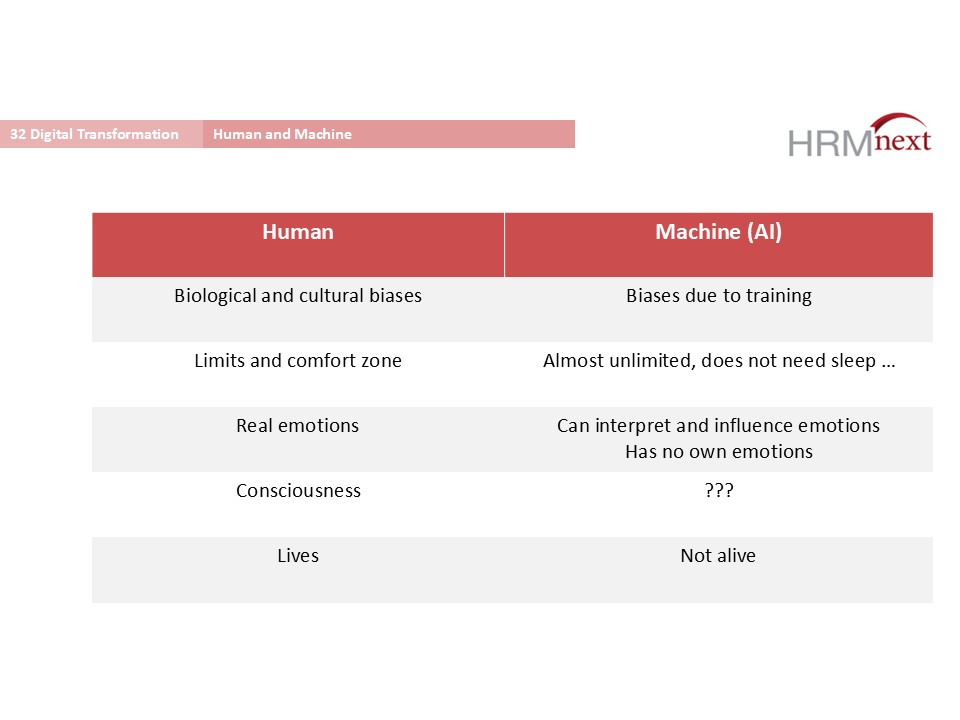
On LinkedIn I posted some general thoughts on our relationship as humans with AI.
Here I will focus on what it means specifically for us in Human Resources Management.
Following the 3 steps in Digital Transformation (1. Business Process Transformation, 2. Business Model Transformation, 3. Business Domain Transformation), here is what I think.
Highly curious about your thoughts!
- Business Process Transformation
This is doing the same things for your customers, just more optimized.
Many of us started this already many years ago in high volume processes such as applicant management or payroll. I think that in a few months from now, most of HR people will do much less routine work. Times of manual entries in systems and copy/paste in-between Excel sheets are or will soon become a thing of the past. - Business Model Transformation
This means that you change the way you are doing things, but in a different way. Think of Netflix who used to rent you DVDs on demand and who turned into a streaming service. Still serving that person on the couch who wants to watch things on their TV, now that person just does not have to waste valuable calories anymore by standing up and putting that DVD in the player …
So Business Model Transformation in HR Management could mean for example feeding HR policies, guidelines and professional advice into a chatbot and let the bot answer. Ideally HR people still can view the chats and intervene, add their insights etc. (there are tools available that blend automated chat with human-to-human chat). Also you can automate the creation of e-Learning courses with AI tools, just feeding them with texts and slides on the topic and receive an animated video, even with an almost real speaker explaining the content.
If you still create courses the traditional PowerPoint way – think twice whether you can find a better use for your time! - Business Domain Transformation
This means, taking your core competencies and start applying them at a completely different place, like Fujji turned from a producer of films for traditional cameras into a producer of cosmetics products – just taking their mass-production capability in chemistry from one to the other domain (they still do films, but it is marginal now).
And for you and me as HR people? What are our core competencies and where else can we use them? I think over the years we have learned a lot about the interface of business needs and humans – both where the needs meet and where they collide.
So, in our case I think we do not have to go somewhere else but to use our knowledge about the business and the people of the company to create competitive advantage of the company we work for. We become performance consultants, counselors, confidants, knowledge managers. In other words: we finally get the chance to really make that move which Dave Ullrich once described in his book “Human Resources Champions”.
 hrmnext.net