Sometimes what once made us successful becomes the very thing that drains us. Many leaders hold on to patterns that used to work — working harder, pushing further, proving themselves once more.
But success is not a static formula. What helped you reach one stage may exhaust you at the next.
Unlearning means questioning the old recipe: Is “working harder” still the way forward — or just the way out of balance?
True Flow begins where we stop confusing effort with meaning.
We’ve spent the last decade pushing corporate learning into the digital space. eLearning, MS Teams, Zoom. AI will make this even more personalized — individual pace, individual needs, individual style.
But here’s the problem: we’ve lost the magic of learning from others. The spark, the shared experience, the emotional connection — everything that used to happen in the “old-fashioned” corporate classroom.
What if we flipped the model? 👉 People learn content individually with the help of AI. 👉 And then, they meet in real rooms, not to consume slides — but to exchange, challenge, reflect and apply.
No training. Real conversations. Real learning.
A flipped classroom approach for corporate learning might be the next wave.
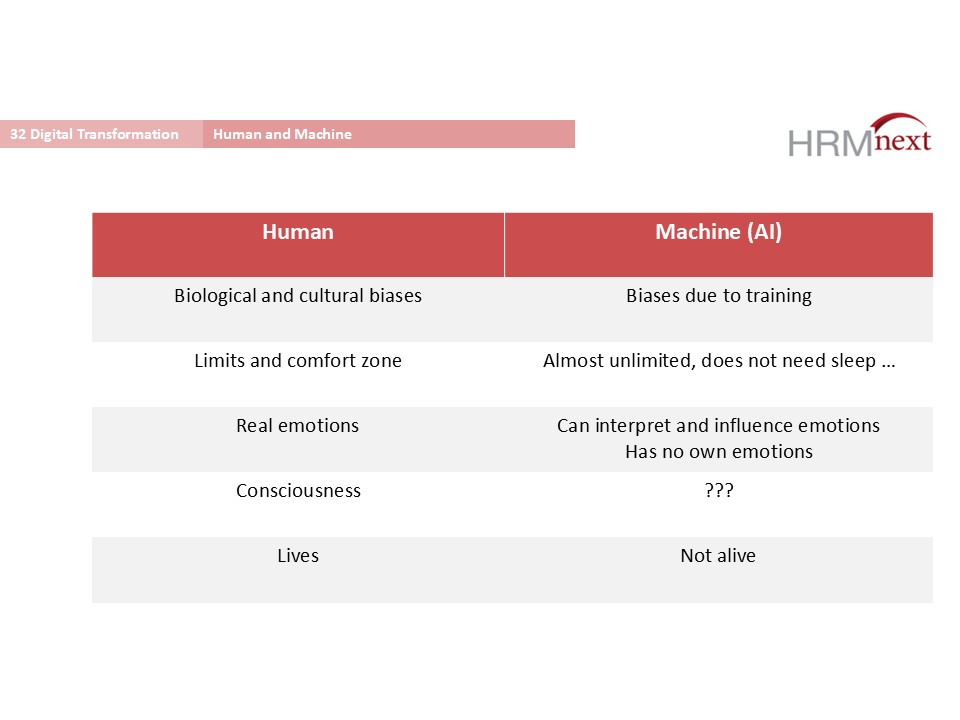
On LinkedIn I posted some general thoughts on our relationship as humans with AI.
Here I will focus on what it means specifically for us in Human Resources Management.
Following the 3 steps in Digital Transformation (1. Business Process Transformation, 2. Business Model Transformation, 3. Business Domain Transformation), here is what I think.
Highly curious about your thoughts!
Business Process Transformation
This is doing the same things for your customers, just more optimized.
Many of us started this already many years ago in high volume processes such as applicant management or payroll. I think that in a few months from now, most of HR people will do much less routine work. Times of manual entries in systems and copy/paste in-between Excel sheets are or will soon become a thing of the past.
Business Model Transformation
This means that you change the way you are doing things, but in a different way. Think of Netflix who used to rent you DVDs on demand and who turned into a streaming service. Still serving that person on the couch who wants to watch things on their TV, now that person just does not have to waste valuable calories anymore by standing up and putting that DVD in the player …
So Business Model Transformation in HR Management could mean for example feeding HR policies, guidelines and professional advice into a chatbot and let the bot answer. Ideally HR people still can view the chats and intervene, add their insights etc. (there are tools available that blend automated chat with human-to-human chat). Also you can automate the creation of e-Learning courses with AI tools, just feeding them with texts and slides on the topic and receive an animated video, even with an almost real speaker explaining the content.
If you still create courses the traditional PowerPoint way – think twice whether you can find a better use for your time!
Business Domain Transformation
This means, taking your core competencies and start applying them at a completely different place, like Fujji turned from a producer of films for traditional cameras into a producer of cosmetics products – just taking their mass-production capability in chemistry from one to the other domain (they still do films, but it is marginal now).
And for you and me as HR people? What are our core competencies and where else can we use them? I think over the years we have learned a lot about the interface of business needs and humans – both where the needs meet and where they collide. So, in our case I think we do not have to go somewhere else but to use our knowledge about the business and the people of the company to create competitive advantage of the company we work for. We become performance consultants, counselors, confidants, knowledge managers. In other words: we finally get the chance to really make that move which Dave Ullrich once described in his book “Human Resources Champions”.
On LinkedIn, I recently shared some general reflections about our human relationship with AI. Here, I would like to take a closer look at what this means specifically for Human Resources Management.
If we follow the three stages of digital transformation – Business Process Transformation, Business Model Transformation, and Business Domain Transformation – HR leaders face very concrete opportunities and challenges.
1. Business Process Transformation
Doing the same things more efficiently
In HR, this started years ago with high-volume processes such as applicant tracking or payroll. In the near future, most HR professionals will spend far less time on routine tasks. Manual data entry, copy-paste work across systems, and Excel juggling are rapidly disappearing. The automation of standard processes will free up valuable capacity for higher-level HR work.
2. Business Model Transformation
Changing the way services are delivered
Think of Netflix, which shifted from DVD rental to streaming – same purpose, but a fundamentally new way of delivery.
In HR, a comparable shift could mean feeding policies, guidelines, and expert advice into chatbots, allowing employees to get quick answers while HR can still monitor, intervene, and add human insights where needed.
Another field: AI-driven course creation. By providing text and slides, AI tools can automatically generate e-learning videos with realistic avatars as trainers.
If your team still spends weeks designing traditional PowerPoint-based courses – it is time to rethink whether that is the best use of HR resources.
3. Business Domain Transformation
Applying core competencies in new domains
A well-known example is Fujifilm. When the market for photographic film collapsed, they did not disappear like Kodak. Instead, they transferred their deep expertise in chemistry and imaging into new fields such as medical imaging, diagnostics, and even cosmetics. Today, photographic film is only a marginal part of their portfolio.
For HR, this is not about leaving the HR domain, but about rethinking our role. Our true core competence lies in managing the interface between business needs and human needs – including the tensions and contradictions.
This gives us the mandate to act as performance consultants, counselors, confidants, and knowledge managers. In other words: AI enables HR to finally move towards the role Dave Ulrich once described in Human Resource Champions: creating real competitive advantage for the business through people.
Question for you: Where do you see your HR function today – at process, model, or domain level of transformation?
In an exchange exchange meeting I had with HR leaders in 2020 f the question came up: Did we select too many fair-weather captains as leaders? People who are great in managing growth, mastering smaller or midsize challenges – but being over-challenged in a perfect storm? We heard about managers who duck and cover, hoping it will soon be over but NOT taking a strong stand, NOT giving orientation and NOT sharing an authentic feeling for the light at the end of the tunnel.
Now, 5 years later: Are we prepared for the next crisis which will eventually come?
In our times of creative disruption, thinking-out-of-the-box, rapid change and transformation nothing seems to be more antiquated than “discipline”.
Discipline stands for doing what you are told to do, repeating patterns without own thinking and following as opposed to leading.
On the other hand, we all can observe how a lack of discipline destroys value:
People checking their emails during meetings
working on unrelated topics during phone- or videoconferences
getting distracted from work by interesting pop-ups on their screens and finally
in the evening sitting at dinner with their partners and checking email.
People losing focus on what they are doing by trying to do several things in parallel.
Yes, discipline in the sense of following orders might be on the decline, however discipline in the meaning of “self-discipline” becomes a key attitude. Disciplining one-self to be there where you are , focus on whom you are with and work only on one thing at a time is key in this brave new world (same as it was before), it just has become so much more difficult.
Coaching is a method to develop people’s skills and behaviors. As a coach it is important to understand and apply the major principles of coaching which are
– Keeping strict confidentiality
– See the world through the eyes of the coachee (Empathy)
– Ensuring clarity about goals of the coaching process
– Clearly limiting coaching to developing the coachee, not allowing it to become psychotherapy (unless the coach is a certified psychotherapist)
– Respecting the coachee’s limits, e.g. areas the coachee does not want to talk about.
Major methods in coaching are
– Providing adequate, precise, development-oriented feedback to the coachee, ideally based on a 360 -degree-survey in advance of the coaching process
– Active listening with full focus on the coachee and paraphrasing to ensure understanding
– Changing of perspectives, e.g. help the coachee to see conflict situation through the eyes of the others
– Helicopter view, e.g. help the coachee to see the big picture
– Leading with questions, i.e. bringing out knowledge and experience the coachee implicitly already has
Learn more about Coaching People and other 19 different areas of leadership in the Leadership Curriculum. Please contact me for more information.
When this crisis began, most of us (including myself) probably thought it will be just a matter of time until we return back to normal, to “Normality 1.0”. There are, however, fundamental changes taking place right now, which cannot be reverted:
Countries and companies suffer in very different ways from the crisis. This changes the competitive landscape and changes relative positions within. Nobody will simply keep their position “for historic reasons”. Past has passed, there is no way back.
This crisis is not over yet and will not disappear before there is a substantial medical solution (vaccination or at least cure from life-threatening symptoms). It will be a deep cut, deeper than anything most of us ever experienced in our lifetimes. Hence, the situation after the crisis will be very different from what is was at the beginning.
Digitized business models will thrive much faster than expected because the crisis paved their way while it currently tends to block the way for traditional face-to-face procurement, production and delivery of goods and services.
I am not a psychologist, so I want to mention this part with all uncertainty I have here: It must have a long-term effect on us being confronted with the topic “death” in such massive way and for such a long time. For several weeks on TV we see these black body bags, fork lifts and trucks transporting them, we see bodies in ICU’s connected with plastic tubes to machines et cetera. I think it must have some effect on the way we see things in life, on our priorities, values.
As a child and young adult I liked movies in which mankind globally finally found together due to an alien attack, realising how things that we as humans have in common are so much more important than things that divide us. Now, the “aliens” are much smaller than expected and they attack from the inside. Although it sounds quite naive, there might be some positive effect in this direction, a global feeling that we are all together in this. Certainly, the current fight for medical equipment does limit this optimism. Still, I believe that some of this “global alliance” feeling will persist.
Taking these five points together, a return to “Normality 1.0” cannot be expected.
We all have to think now how “Normality 2.0” will look like and how we can prepare ourselves for this.
What are personal consequences from this?
I suggest to think of what core competencies made you successful so far and what realistic future scenarios are, in which you still can leverage these competencies. Which will be the additional demands (very probably related to digitization) in these scenarios and what can you do to master these? The book “The Fourth Industrial Revolution” by Klaus Schwab, Founder and Executive Chairman of the World Economic Forum, provides valuable orientation for this.
For some this time means a lot of additional work, for others it is a time to take a deep breath and … learn new things. If you belong to the second group (members of the first group will probably not read articles like this at the moment …), my advice is to use the time for learning those things that will be necessary for your success in “Normality 2.0”.
Oh yes, more than ever before! We need leadership to provide guidance, orientation, future perspective and encouragement in a time ahead, which will be full of challenges and uncertainties.
So the right question regarding leadership training is, whether it leads to an effective increase of leadership.
Does it?
Classical classroom training in leadership is not an option in times of travel restrictions, crisis-reduced budgets and social distancing. And let’s be honest: classroom training was on decline long before the Corona crisis started: Often travel cost and travel time were higher than the cost of the training itself, and last-minute cancellations contributed even more to the ineffectiveness. In addition there is always a lot of administration necessary to make classroom training happen.
So online video tutorial seemed to be the solution: 24/7 available, low cost, perfect! Really?
There is are lot of high-quality online tutorials available, some of them even cost-free. It is a great resource
· to prepare a learning experience
· to add to a learning experience or
· to follow-up to it.
It just doesn’t replace the learning experience itself, not when it is about leadership.
In an effective learning experience in leadership, the learner connects content with her own reality and applies the content in her reality afterwards.
To make this connection between learning content and own reality, a learning experience in leadership has to be interactive. And this is exactly what online tutorials are not. Elaborate versions might check your knowledge acquisition with a multiple choice and send you back to start if you got it wrong, but they can not help you in transferring learning content to your current leadership challenges.
In-between highly interactive / high cost classroom training and low interactive / low cost video tutorials are webinars, in other words: virtual classrooms.
Webinars are relatively low-cost because participants can learn from wherever they are. Still webinars are highly interactive with screen sharing, audio- and video connection, shared virtual whiteboards, instant polls and more.
In the past 20 months I trained about 1,500 managers in leadership via webinar. In the beginning it was not always easy, because both trainer and participants have to get familiar with this new format.
Step-by-step, however, all learned to use the new features: commenting via chat function, playful usage of the shared whiteboard, anonymous polls about sensitive questions, here and there a short video sequence to include some entertainment – just to name a few.
Personally I still prefer to be with a group in a real room, walk around, look people in the eyes when I talk with them.
A webinar, however, is a great second winner: still not as good as the original face-to-face experience – but over time with more experience in using all features almost as effective.
If you have not yet experienced a leadership training via webinar:
When things get rough, many people look for orientation. This is the moment for managers to step up to become real leaders.
Managers have a repertoire of tools and methods to steer their area of responsibility under more or less expected conditions. Checks and balances are there to initiate corrective actions to bring the area back to normal. Deviations from the norm are seen as temporary. Management is for fair weather with some rain and thunderstorms from time to time. Management does not work in a Tsunami or any other form of game-changing catastrophy.
Leaders provide orientation and a feeling of shelter in times of crisis – even though they do not have any more personal safety than anybody else. Are they super-heroes? No, leaders have the same fears as anybody else, they simply follow the meaning of a quote that is (probably wrongly) attributed to Martin Luther: „Even if I knew the world would end tomorrow, I would plant an apple tree today.“ This means: creating a form or normality, or positive routine that gives a perspective of a positive future.
What are such new (or old) routines that help develop a positive outlook in times of an all-encompassing crisis? These are not spectacular types of things, it starts with small things that you simply just do with consistency.
Here are some examples for those who lead their teams now remotely:
If you promised to have one weekly Skype with all of your team per week – just simply do it! Do not find excuses why this week you are too busy, again: simply do it.
If there is a birthday of a team member, a message to him/her and all in CC does the trick. Many others will follow your example and it becomes a small virtual birthday party.
Talk with each team member at least once a week, and also ask them how they personally are. And in case you have difficulties remembering such personal things because you have been trained all these years to focus on business stuff: Write also these personal details down to remember next time you talk with him/her.
Simply listen. Give people time to talk to you. Ask back, repeat in your own words to make sure you really understood what they said, reflect feelings back by saying things like “this must be difficult for you”, acknowledge effort and achievements by saying things like “despite of these challenges it is amazing how you got this done”.







 hrmnext.net